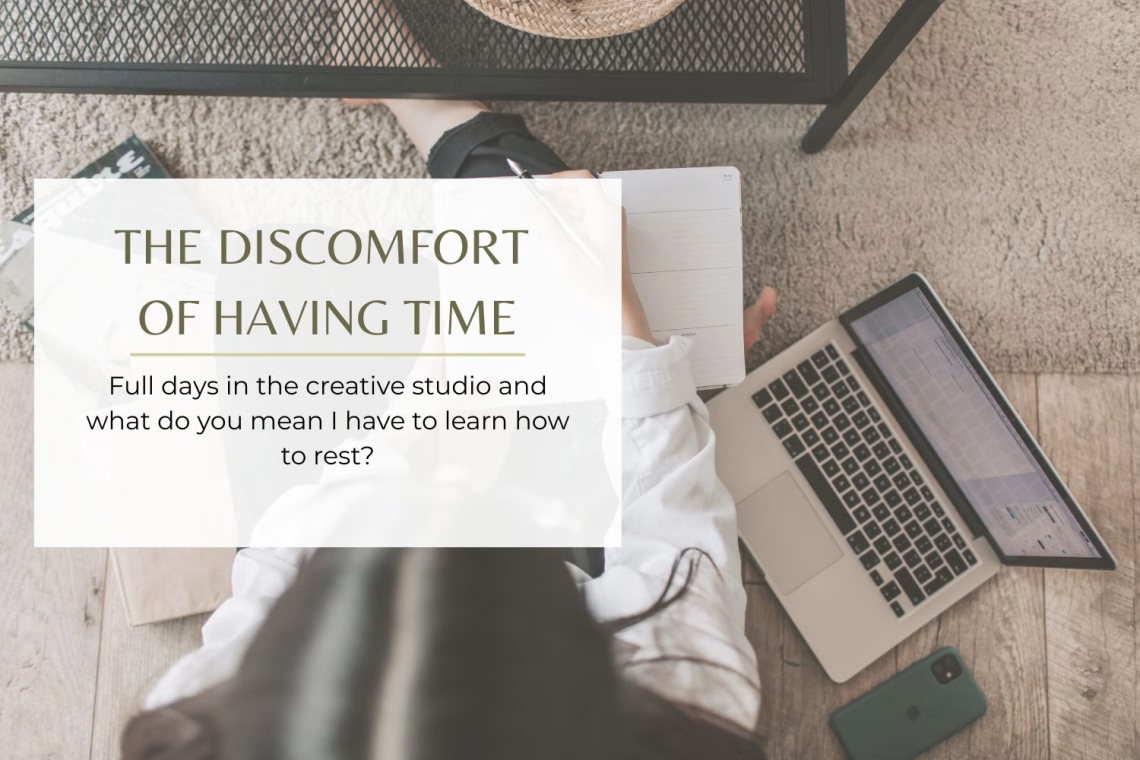
Less than a year ago, I traded full days in the office of an accounting firm for full days in my creative studio. I assumed that stepping out of a structured work life into an unstructured creative one would be a breeze.
The reality was more complex. I loved the new pace of life, and the work felt exciting and alive. But beneath the excitement was the odd discomfort of… Having time.
The extra time felt like something I wasn’t allowed to have. I felt an immediate, internal pressure to do something — to perform, to be valid, to be worthy of the time and space I now had. As though there was something intangible about my presence that had to be earned, and for once, there wasn’t much I could do to earn it.
I certainly tried, though.
Struggling to transition from a structured work life to a creative one
Those were echoes of the old programming. The habits that used to help me survive and thrive in my corporate career were still there — perhaps even stronger now because they were wearing the mask of more meaningful work.
I have to credit Adam Savage on his YouTube channel, Tested, for some serendipitously timed insights into the struggle of making such a jump. (Adam Savage is a multipassionate maker and was the co-host of the show MythBusters, which I loved to watch growing up.)
This video, How Adam Savage Adjusted When His Day Job (MythBusters) Ended, inspired and informed this essay.
It happened that he had been working on MythBusters year-round for thirteen years — the same length of time I’d spent at my accounting firm. Although his role on MythBusters was creative, the job itself was quite structured, so there was enough similarity between what he was saying and what I was experiencing that my discomfort felt entirely validated.
After MythBusters ended, he did precisely what I did and treated every studio day like a proper work day. It’s the logical thing to do, isn’t it? Same routine, but new, more expansive creative environment.
But when I did this, the show up, care deeply, and grind mentality that carried me through accounting followed me to the studio. I had to be on time for some reason, and I demanded a certain level of output for myself. Everything I did creatively was shrouded in a veil of urgency.
This wasn’t accounting, though, and it wasn’t what I had envisioned for myself. I didn’t want the pressure — I wanted presence.
It was hard to convince myself of that. I think I knew better — I had been painting and blogging for a few years before, so I knew that creativity doesn’t come through force. But I also believed that the muse must find you working, so I worked at this pace for quite a while.
It turns out, it wasn’t just accounting spillover that was turning up the heat — it was the creative ambiguity, back to haunt me again. (I wrote about creative ambiguity as part of the essay, Creativity, Lost and Found, where I found myself channelling that creative energy into my career.)
The scarcity response to creative ambiguity
Creative time has always felt rare to me. It was stolen during early mornings, after my kids’ bedtime, and in bits on the weekends — if nothing urgent popped up at work.
But in his video, Adam articulated the scarcity response to creative ambiguity even more precisely, and it really resonated:
“For the largest portion of a creative person’s life, the amount of time they get to spend in their studio is always a fight… When you do something as strange as exploring your own creative proclivities in a space without guidance or boundaries, [it’s hard to safeguard, justify, or quantify that time in a meaningful way].
So [if] you’re going to go into [the studio] for eight hours and you don’t know what you’re going to do when you get there, and you don’t know how it’s going while you’re there, it means that when someone comes to you and says ‘hey, can you have lunch on Tuesday?’… It’s sometimes hard to say ‘no, because I need to go do this thing that I don’t know what it is and doesn’t have a structure yet.’”
That’s all to say, there are a couple of things that push ambiguous creative time toward a scarcity model:
- The people around you may not understand why you need to spend so much time in the studio — it’s hard to explain.
- If you have a day job, you risk draining your energy before you even get to the studio, making any time you do spend there even more precious.
The feeling of scarcity doesn’t evaporate when you suddenly have full days in the studio to create. We’re too used to guarding that time vigilantly because every moment needs to count. What’s more, if you’ve been fitting creative ideation time into the cracks of your days, this habit sticks, too.
“We can feel an outsized amount of responsibility to take what free time there is and execute the endless to-do lists in any of our brains.”
Honestly, I think the scraping together of free time to work on creative projects is what helped me stay in accounting for so long — but once creative projects became the work, the habit started working against me.
Breaking the scarcity cycle
After I left, I told people I was still “resetting my nervous system,” and I’d receive nods of understanding in response. But it wasn’t really about recovering from spillover work stress — it was about reprogramming this ingrained belief that creative time is scarce.
I’ve had to look differently at my own endless mental to-do lists and my true capacity to actually execute them. Accounting trained me for ten-hour days, but writing? No more than two or three hours per day, with maybe some light administrative work after that.
It’s taken the full nine months since I left to realize and be somewhat comfortable with this notion that I don’t actually have to run to the studio in the morning. I can slow down.
I’ve had to accept that creative output also requires creative input and time to percolate — rest time.
In that same Tested video, a viewer explained that they had turned their creative passion into how they make a living (woo-hoo!), but they have trouble switching their brain off for a rest — a day, an hour, or even a few minutes.
So, how do we practice the art of resting?
Adam’s answer was to intentionally do nothing.
Resting time won’t feel natural after operating in the scarcity model for so long, so intentional “not doing” feels uncomfortable. But we need it to keep creating. The key is to feel the guilt when it creeps up — and also to recognize that not doing is vital to the creative process. Without it, you stagnate… Or burn out.
That means an important part of resting — or not doing — is “repeatedly forgiving yourself for not doing.”
I think the guilt itself is just another variant of the inner critic.
She’s loud. She’s the one who says this topic is stupid. She’s also the one telling me you’re not doing enough. I strongly suspect that she was the one telling me I wasn’t allowed to have the extra time — that it had to be earned, and that every time I had to stop writing at the two- or three-hour mark, I was failing.
She doesn’t believe in rest. But I do.
Adam’s experience was that when you incorporate rest, it actually makes it easier to deal with the inner critic and let it pass, rather than letting it settle.
Rest won’t get rid of the inner critic entirely — I think she’s there for a reason, and we’re right to hear her out — but she doesn’t get to call the shots. In that sense, intentional not doing helps us stay in the driver’s seat of our creativity, and to let her pass once she’s been heard.
To create anyway.
Originally published on Substack: The Discomfort of Having Time
Thank you for reading! I also share reflective writing like this weekly over on Substack.
If this post resonated, you may also enjoy:
The Busy Professional’s Guide to Creative Self-Care — Small acts of creativity that fit into a busy life.
The Creative’s Guide to Rest: 7 Ways to Restore Your Energy — Explore the many forms that rest can take, and which one you might need now.
The Busy Season Survival Guide: Part 5 – Rest and Recovery — Insights from this accountant’s many busy seasons.
The 5-Minute Reset: A Simple Routine to Declutter Your Mind and Refocus Your Day — Whether you’re kicking off a work day or a studio day, this routine can get you grounded and focused for what’s next.