Guess what just released today! It’s Scott Christian Sava’s book, Becoming an Artist: How to Make Art Like a Human by Embracing Failure, Discovering Your Creative Voice & Finding Joy in the Process (Hay House LLC, 2025).
I went to write a book review, but it wound up a personal reflection with a book review in it.
I was curious what it would be like to write book reviews, but ultimately, I had a lot more to say than would probably go into a normal review (who could have guessed). I hope it’s helpful nonetheless!
But first, who is Scott Christian Sava?
His publisher describes him as the internet’s “art dad”, and I couldn’t agree more.
I happened upon Scott Sava while on my first maternity leave in 2020 (yup, the year is significant). The algorithm must have introduced us because I was on an art kick at the time, but what really intrigued me?
His home art studio is a hobbit hole. Really — he crafted it to be so.
Ah. I’ve found my Shire-folk.
Then I discovered that he also had many short clips about how to do certain things in art, such as drawing noses, eyeballs, and hair. I learned a lot.
What was more compelling still, particularly given the year that 2020 was: a few times per week he would go live (usually with his lovely wife Donna), and he would chat with the community while making art, in real time.
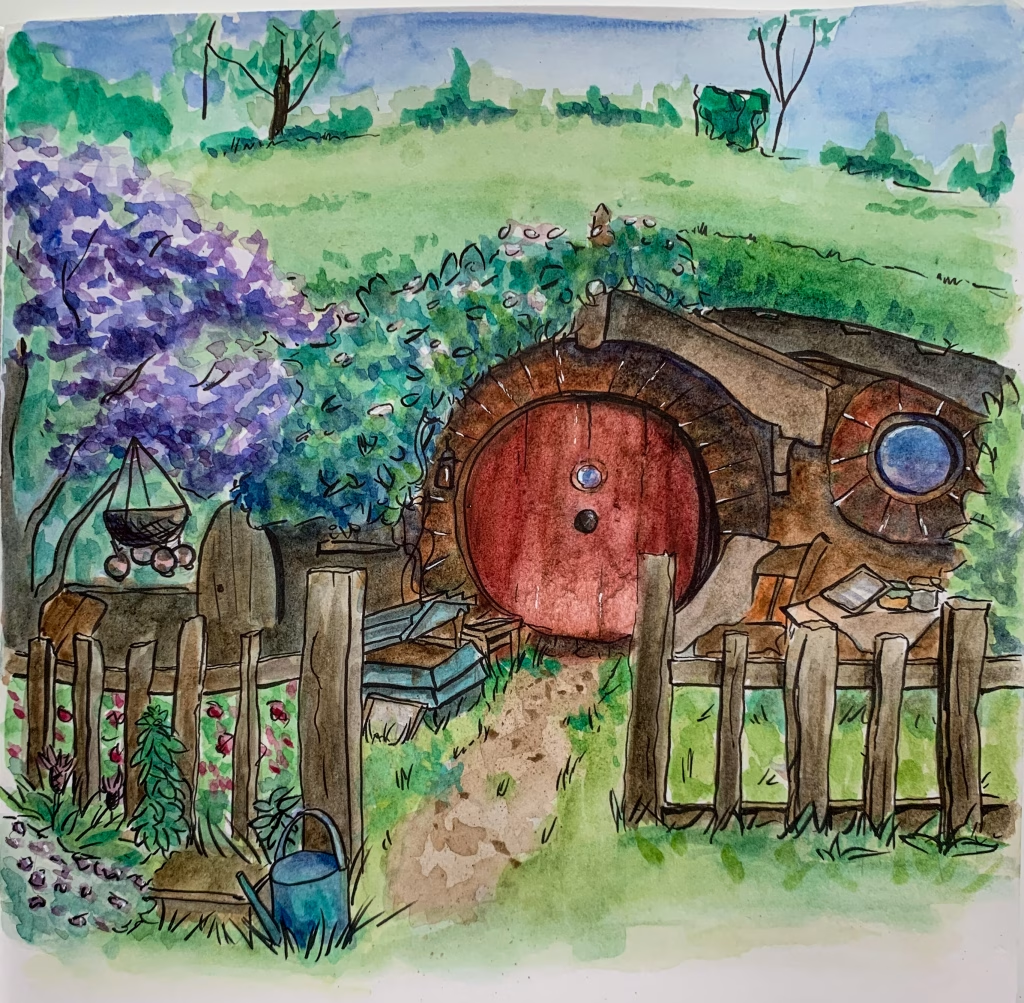
Watching a professional artist (and fellow hobbit) make art from scratch in real time — and witnessing the thought process, the mistakes, and the creative ways he’d correct them — was pretty awesome.
But his doing so while chatting with the community and answering questions from other aspiring artists? Foundational. Without ever intending to, I learned so much about myself, creativity, and being human, simply through resonating with what Scott and Donna had to say on their livestreams.
They talked about all sorts of things, usually art-related, and when tough questions from aspiring artists came up, they would respond honestly and off-the-cuff.
To the artist whose art teacher crushed their spirit.
To the artist feeling defeated because they couldn’t afford to go to art school.
To the artist who was told they were doing art wrong.
Scott and Donna exude a down-to-earth kindness and a genuine humility that kept me company, and kept me grounded, on a lonely, anxiety-ridden pandemic maternity leave while shaping who I am creatively today, what I write about, and why.
And although I have mentioned Scott Sava on the blog before, I was really reminded of everything I’d learned from listening to him years ago while reading his newly published book.
Book Review — Scott Christian Sava’s Becoming an Artist
You know those aspiring artist questions — the real, vulnerable ones that Scott answered in real time for his growing community of artists?
Every time he’d answer one, it was like being given a little bit of treasure. A nugget of what felt like magical truth that you could carry with you the rest of your creative life. That is the stuff the book was made of. Literally!
So if you’ve ever wondered…
- Who decides who is an artist, and what art is?
- Is there’s such a thing as cheating in art?
- What do you do if you get artist’s block?
- Should you pursue a career in art?
- Do artists need to suffer for their art?
- Should artists be activists?
Then this book is for you.
Of course, in addition to the titled concepts of embracing failure, overcoming self-doubt, and rediscovering the joy of creating art, there are great tips for making it: supplies to use, tips for finding your style, planning a piece, improving your technique, and embracing storytelling in art. Technical discussions are high-level, as this isn’t an instructional art book.
It really is about becoming an artist, in the fullest sense.
Scott pulls from his personal experiences with a playful yet honest lens. His writing style is conversational, quite literally: this book is unmistakably written in his voice.
In the book’s description, his publisher refers to Mister Rogers and Bob Ross, and I find this hilariously accurate — I thought precisely the same thing before I read that! His humility, conscientiousness, and genuine care for his fellow human beings permeates throughout the book.
Becoming an Artist is a book of creative encouragement for courageousness, kindness, and authenticity that demystifies the prestigious titles of “art” and “artist” and grounds them for everyone.
I love this book (and the sketches in it)! Although I do paint, I’m primarily a writer, yet Becoming an Artist still resonates for me. It’ll be a treasured creative companion, lined up with Elizabeth Gilbert’s Big Magic on my bookshelf of creative influences.
I challenge you to read this book and continue to doubt your own artistic becoming.
I’m grateful to have received an ARC, provided by NetGalley and Hay House LLC for this review. Thank you!
Scott Sava’s influence on my creative life and writing
I’ve made a lot of general comments on how Scott Sava has influenced my creative life above. I wish I could put my finger on one or two solid concepts for you. But it’s not big, novel ideas or metaphors that I pull from. It’s more his and Donna’s essence influencing the direction of my own creative flow and making itself at home there.
So yes, Scott helped me draw eyeballs and noses better. He also inspired me to try more portraits, some of which I’ve done in a style inspired by his.
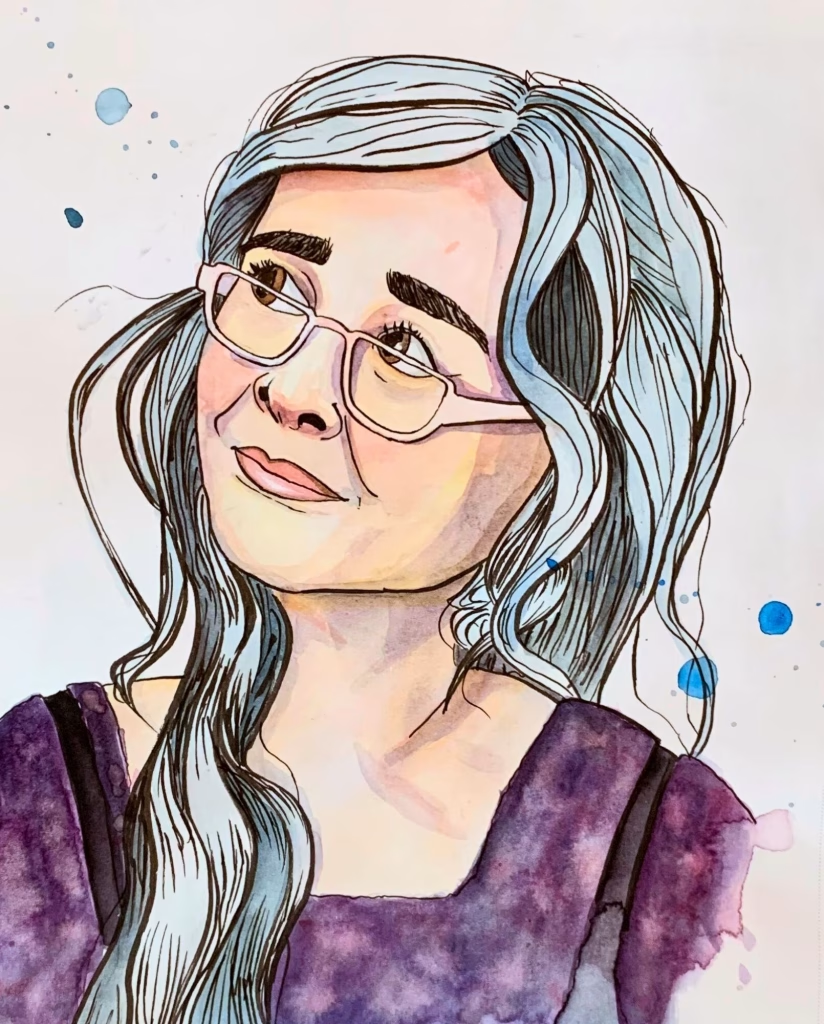
But he influenced my writing as well. I think my passion for encouraging beginners to begin comes from listening to Scott and Donna. The same can be said for my focus on digging deep for that authentic self-expression. And whenever I write about finding a creative hobby or creative self-expression, I can hear his voice:
“The world needs more art. The world needs your art.”
Yes, yours.
Layered onto the journey of Becoming an Artist are the trials and tribulations of simply being human in a world that challenges our sense of humanity. To me, art is more than a skill, hobby, or profession: it’s an honest expression of ourselves out into the world. One that comes from self-understanding and self-acceptance.
I wrote very recently about creativity as the catalyst for compassion, empathy, and knowledge to connect, grow, and heal. If you’re curious to read more, you’ll find it here: The Words We Choose (National Addictions Awareness Week 2025 — Anchoring Hope). Note this was a piece I wrote for National Addictions Awareness Week, so if you do head there, please read with care.
Here on the blog, the motto (that perhaps I’ve not shared as much as I should) is this:
The world needs more happy creatives.
(And we’re all creative, by the way.)
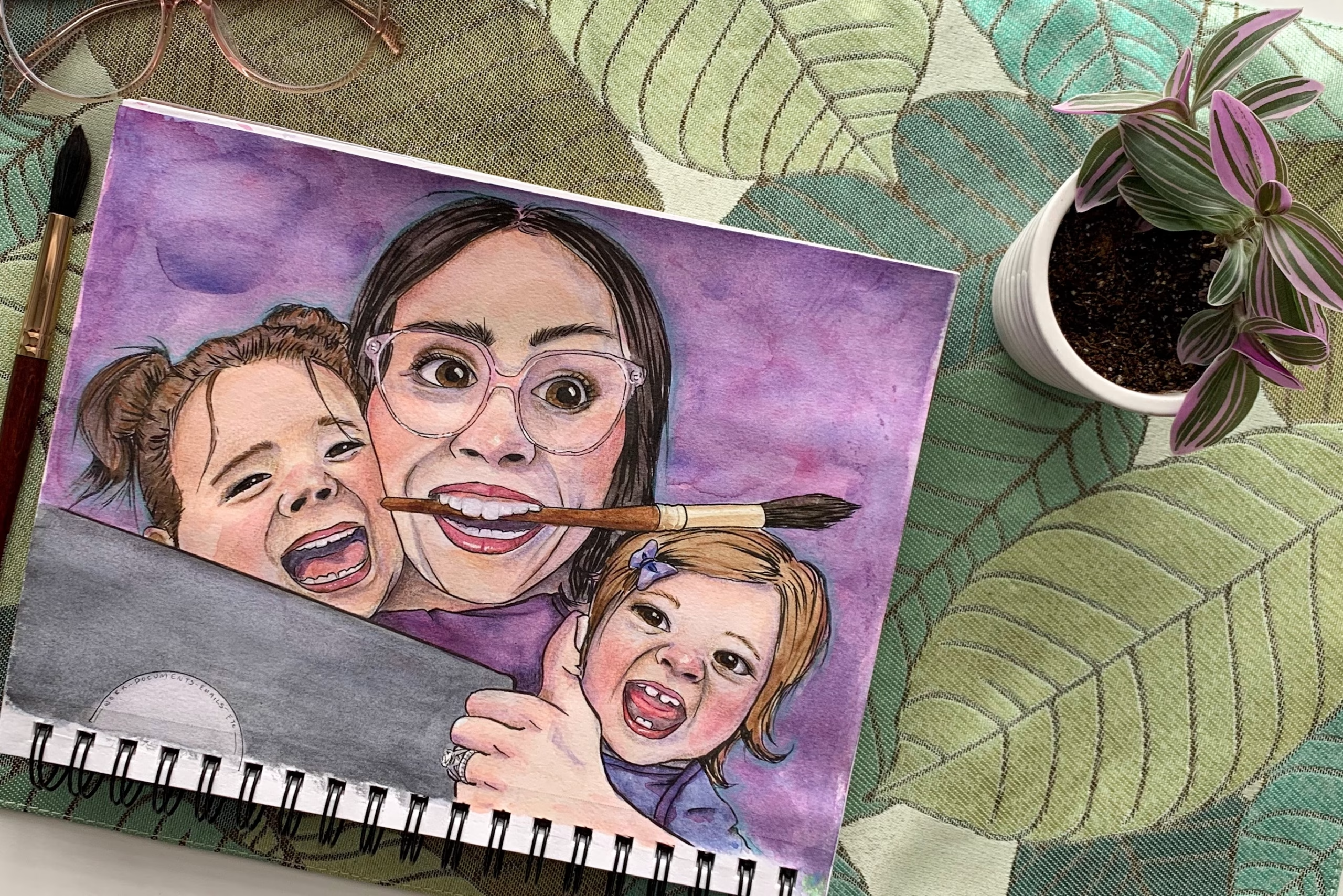
If you’re interested in exploring your own creativity beyond this book, you might also enjoy:
My favourite takeaways from Becoming an Artist
I’ve mentioned some fundamentals above, but I thought it would be worthwhile to pull out a few more of my favourite takeaways from the book.
Note these are my takeaways from some of the chapters in the book, and not necessarily the point of the chapter itself:
1. Artists make art.
If you make art, you’re an artist (and don’t let anyone tell you otherwise).
We writers struggle with the same thing — I want to be a writer, but… I don’t have a published book. I can’t get a job as a writer. I don’t have a readership. (And so-on.)
I’ve grappled with this myself, especially after my recent career pivot from a public accountant to… What even is this? Who am I now?
Oh, yes — an artist, and a writer.
2. Make art that makes you happy.
Creative folk are often sensitive folk. We feel. Feeling is part of the business. And often, we feel a duty to make a statement, advocate for change, start or join a movement. (Scott answers the question, should artists be activists?, beautifully in the book.)
We can get caught up in our responsibility as artists. And while making the world a better place is always important, you do need to take care of yourself as an artist and just make art that makes you happy.
Joy is the key to authentic creative self-expression.
3. Be a good human being.
I think this is fundamental to everything that Scott does, and certainly to what he has written. Since his book is about becoming, this makes perfect sense to me.
You can choose to be an artist, sure — but moreover, we all get to choose the type of person we want to be.
And we can choose to be kind.
4. Poop out the bad art.
There’s a wonderful storyline in the book of how Scott’s art skills developed, and just as one could predict: it was non-linear, and full of poop.
Good.
This is another thing that stuck with me (and actually kept me going in the first year… or two… of writing this blog): Sometimes you have to make 100 bad drawings to get one good one.
So you may as well get to work on those 100 bad drawings. Eventually, it will only take 50 drawings to get to a good one.
And then 15.
Take it from this accountant: growth compounds!
5. There’s no such thing as cheating in art.
Scott’s take on things like trying to learn someone else’s art style, or using tracing tools, multiple mediums, or heck — even reference photos — is liberating.
Now, there is plagiarism, don’t do that. But using tools to make art, mixing mediums, or borrowing and learning from other styles? Not only is that not cheating, but that’s actually how you find your own style and improve your technique.
This certainly unlocked some creative freedom for me!
But of course, if you’re borrowing from another artist, it’s kind to credit them!
6. Your voice, your story, and your art, matters.
Don’t let anyone make you feel invisible.
There are wildly talented artists out there, and it can feel like your amateur art doesn’t have a place in the world.
There are huge, important pieces of art that make political statements or commentary on the human condition, and it can feel like your happy little flowers don’t matter.
The beautiful part is this: There’s a place for everyone. The world is made of (and for) all of us. And while innate talent inspires awe, a bold beginner inspires vulnerability, and other beginners to start. Deep, meaningful works can help move us toward change, but a simple, happy little flower can help move us toward joy.
I’ll leave this one with a quote:
The world needs us artists. It needs our art in whatever form we wish to create. It needs poets and painters and dancers and singers. It needs art in color and in text and through weaving and rhyming. The world needs all of it. And not just good art. No. The world needs messy art. Beginner art. Unfinished art. Overworked art. Unremarkable art. “I have no idea what I’m doing” art.
Scott Christian Sava, Becoming an Artist (p. 21)
Parting words
I think I’ll wind this one up with gratitude. A big thank-you to Scott and Donna for their influence on the shape and trajectory of my own creative career, for being wonderful human beings, and for inspiring other wonderful human beings to be wonderful.
Want to know more? Here are some resources:
- Scott’s artist’s website: The Art of Scott Christian Sava | Artist
- Becoming an Artist: Becoming an Artist: How to Make Art Like a Human by Embracing Failure, Discovering Your Creative Voice & Finding Joy in the Process: Sava, Scott Christian: 9781401996932: Books – Amazon.ca
- Scott’s YouTube channel: Scott Christian Sava – YouTube
- Donna’s YouTube channel: DSavaProducer – YouTube
And finally, if you’d like a little monthly encouragement to embrace your creative calling, I’ve got you! Head over to my monthly newsletter, and let’s connect: Kindling for your creative spark – right to your inbox.