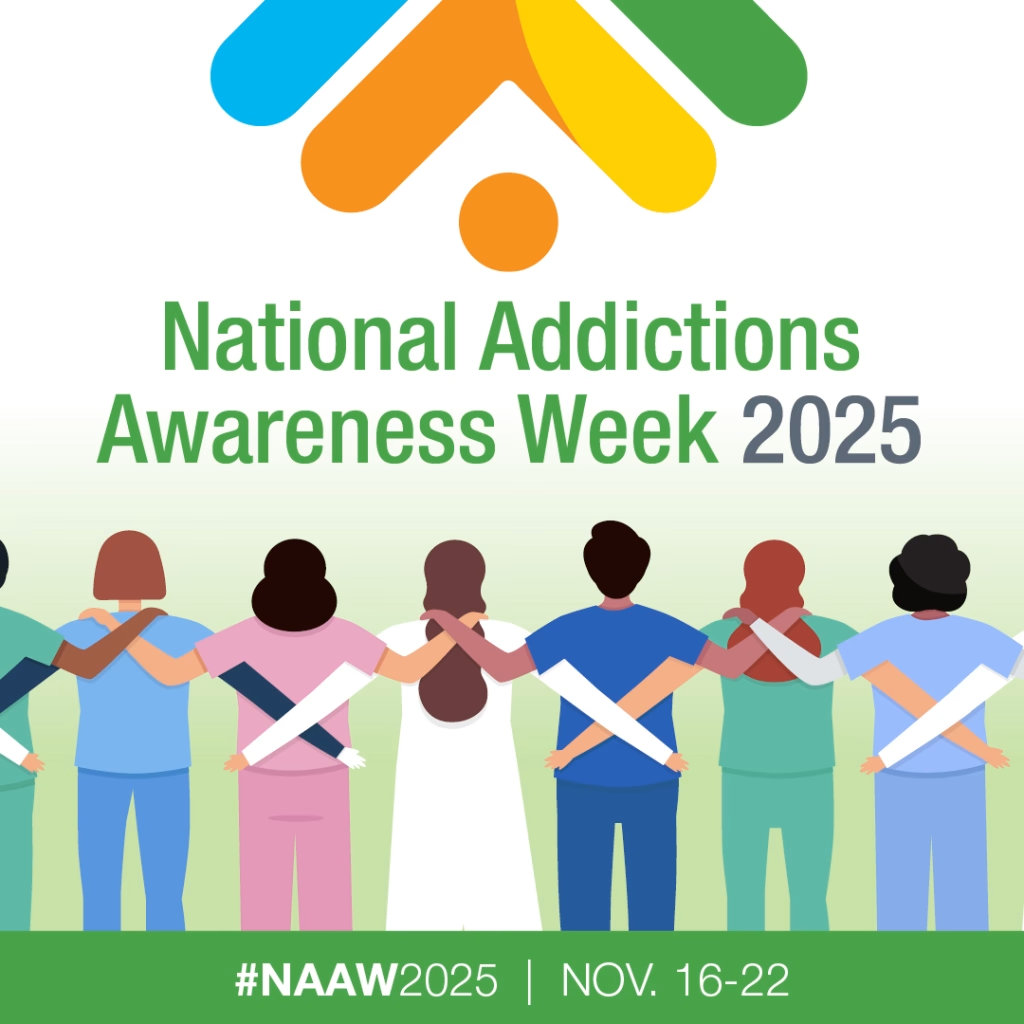
It’s National Addictions Awareness Week in Canada (November 16th to 22nd, 2025), and this year, we’re anchoring hope.
Borrowing from the Canadian Centre on Substance Use and Addiction statement: “Hope is an optimistic state of mind that holds expectations for positive outcomes.” Positive outcomes like connection and growth. “We need effective, holistic, whole-of-government and community action that is rooted in evidence and compassion.”
So let’s start at the roots and have a discussion, guided by compassion.
Content note: This post discusses substance use, healing, and recovery in the context of National Addictions Awareness Week. If these topics are sensitive for you, please read with care, and know you can take breaks as needed. Resources for support are listed below.
On compassion, empathy, knowledge, and the creative catalyst
The driving force behind a lot of my writing, and why I talk about creativity so much, is because the world needs more compassion, empathy, and knowledge — to connect, to grow, and to heal.
I see creativity as a catalyst for growth in these areas.
Yet we have the ability to almost instinctively close our minds off to our fellow humans who have different experiences, different challenges, or different viewpoints than ours. It’s all too easy to make assumptions or pass judgment without first stopping to notice our own reaction and where it came from.
(And this can be completely unintentional, by the way.)
If we could stop to notice, I bet there would be a lot more productive understanding of one another, and a lot less judgment going on. Different viewpoints or values wouldn’t seem so threatening.
Could it be that we react because we have rigid belief systems that were handed to us, rather than having been cultivated from our own sense of truth? Or is there a part of ourselves we’ve inherently rejected, that is now being mirrored back to us?
And could that part of us use a little compassion? So that maybe the compassion is what we mirror back to the world, rather than the fear and judgment?
Creativity comes from the heart. When we embrace our creativity, we understand ourselves better and more deeply, and we’re able to reach for that self-compassion.
It’s when we understand ourselves, and we feel secure in that understanding, that we truly start to open to the experience of understanding others, without the reactivity.
As RuPaul puts it, “if you don’t love yourself, how in the hell you gonna love somebody else?”
This is the bit that the blog focuses on, but today we’re looking at what happens next.
We start learning about the experiences, challenges, and viewpoints of others to gain knowledge.
Knowledge blossoms into understanding, which opens us to empathy.
Rooted in our empathy, we can act from a place of compassion — and this is healing, for everyone.
Compassion, empathy, and knowledge are three words that can help us anchor hope, and I think they’re also at the heart of this discussion on the words we choose.
The words we choose (and why they matter)
Several years ago, I was volunteering as treasurer at a really wonderful local rehabilitation centre, and I was immediately struck by the weight of the words we choose.
I’ve picked three that I think illustrate this point well. As a bonus, I hope they’ll help us continue to have conscientious discussions that promote collaboration and hope.
Reducing stigma: addiction → substance dependence
At the time, I remember very minimal use of the term “addiction”. Why? It comes loaded with stigma, it carries an undertone of blame, and it creates a “them-versus-us” attitude that creates more division than collaboration.
Perhaps worse still, the term “addict” can come off accusatory, devalue one’s individuality, personal experiences, and the complex factors behind substance use. It ignores personal or intergenerational traumas, harmful pervasive societal conditions, neurological dispositions, and any number of other factors that might contribute to substance dependence.
Words carrying stigma can put distance between the speaker and those impacted by substance dependence, and that separation can give the unintentional sense that this issue (and the stigma behind it) is not the speaker’s responsibility.
But we all have a responsibility to each other as human beings.
Now, why are we calling it “Addictions Awareness Week”? I can’t say for sure, but my understanding is that it’s for awareness. There are many community members out there that recognize “addiction” more quickly and clearly than “substance dependence”. Particularly for healthcare professionals, I assume that the awareness and clarity piece takes priority over the stigma — for now. This is the statement from the Canadian Centre on Substance Use and Addiction:
We appreciate that the term “addiction” can be stigmatizing for some people and an important point of discussion for other people. Our goal is to raise awareness about substance use health, addiction and people who use substances to improve people’s health and well-being.
The ability to heal: empowerment → support
I came into the organization energetic and well-intentioned, wanting to make a difference.
I want to empower others to heal, I proclaimed. But the CEO at the time graciously corrected me:
We don’t empower our clients. It implies that the power to heal is something that someone else has to give to them. It’s not. They have the power to heal — they are already empowered themselves.
Wow. That stuck with me strongly, and I still think about it today.
Merriam-Webster Dictionary defines empowerment as “the act or action of empowering someone or something: the granting of the power, right, or authority to perform various acts or duties”.
Not one of us holds the power, the right, or the authority to unlock someone else’s healing.
We have the power, the right, and the authority to heal within us already.
What we can do is co-create safe, compassionate spaces that support others in the process of self-empowerment, so that they may embark on their unique journey of self-discovery and healing.
When we can approach the topic of substance dependency and healing with open hearts and minds, with compassion, we can find a way to work together and commit to co-creating healthy and safe communities.
Co-creation: clients → individuals and community members
If I recall correctly, many years ago, we referred to our program participants as clients. This was a significantly more accurate term than what might historically have been “patients” in the industry — a well-meaning term for someone receiving care; but again, we’re not here mending broken bones.
We’re walking together on a healing journey.
But I perceive another meaningful shift, from clients to individuals or community members.
The term client is more empowered than patient, but it does have a somewhat transactional feel, and rehabilitation can’t be reduced to an exchange of service. To truly support those embarking on their own healing, we need to recognize two important factors:
- Each individual is on their own journey, and the words we use should reflect that. Although programs exist, there’s flexibility within them because there is no “one-size-fits-all” approach to healing from substance dependency.
- Community building is vital to healing. I’m not a mental health practitioner, so I won’t attempt to get into the specifics of why, but fundamentally: We humans need community. A safe, healthy community is a vital part of anyone’s healing journey.
To be individuals, and to celebrate our individuality, in a safe and supportive space that can appreciate both our individuality and our togetherness, requires co-creation.
Much like one doesn’t empower another to heal, one doesn’t just create a community and then plop you into it. Communities are created by the connections between the unique individuals within them.
Parting words
First of all, thank you for reading — this topic diverges from our usual creative reclamation topics, but it’s relevant and meaningful to me. So I appreciate your openness to this important discussion!
Words are powerful. With great power comes great responsibility, so let’s use them well.
Secondly, I think there’s a tendency to decide what’s best for other people (there’s that empowerment piece again) without first taking a little moment for our own self-empowerment. As we hold space for others, let’s also hold space for our own healing, whatever that looks like.
Rooted in knowledge, empathy and compassion, we can co-create an environment for healing for everyone.
And finally, if I have used words that do not anchor hope and contribute positively to the discussion, please reach out. I want to continue my education and grow my own knowledge, empathy, and compassion.
The work of being human is never done — and never meant to be done alone.
Please note: I’m not a mental health professional. This post contains reflections from personal experience and what I’ve learned through community work. If you or someone you know is struggling with substance use, please reach out to a qualified support service, or explore resources such as these:
- National Addictions Awareness Week | Canadian Centre on Substance Use and Addiction
- Get help with substance use – Canada.ca
- Find help for substance abuse | USAGov